
Search is no longer confined to Google’s familiar blue links. the way people discover information, products, services, and brands has fundamentally changed. Search now happens everywhere. It happens inside AI chat interfaces, social platforms, marketplaces, voice assistants, video platforms, app stores, and even within private communities. Because of this shift, businesses that continue to optimize only for traditional search engines risk losing visibility where real discovery increasingly occurs.
This is where Search Everywhere Optimization becomes essential. Rather than focusing on a single platform or algorithm, this strategy aligns your brand with how modern users actually search. It acknowledges that discovery is fragmented, intent is multi-layered, and decision-making spans multiple touchpoints. As a result, Search Everywhere Optimization is not a replacement for SEO but an evolution of it, one that blends classic search principles with AI-driven visibility, content distribution, and omnichannel presence.
Building a Search Everywhere Optimization strategy for 2026 requires a deeper understanding of user behavior, platform dynamics, and how AI systems interpret authority, relevance, and trust. It also requires marketers to think beyond rankings and focus on presence, consistency, and contextual relevance. This guide explores six foundational ways to build a resilient and future-proof Search Everywhere Optimization strategy, designed to help brands stay visible, credible, and competitive in an increasingly decentralized search landscape.
Understanding What Search Everywhere Optimization Really Means
Before exploring how to build the strategy, it is important to clarify what Search Everywhere Optimization truly represents. At its core, it is the practice of ensuring that your brand, content, and expertise are discoverable across all platforms where people search for answers. This includes search engines, AI assistants, social networks, video platforms, marketplaces, forums, and emerging discovery channels.
Unlike traditional SEO, which focuses heavily on ranking for keywords in Google, Search Everywhere Optimization prioritizes intent coverage. It asks where your audience searches, how they phrase questions, what formats they trust, and which platforms influence their decisions. As AI-powered discovery becomes more prevalent, especially through conversational interfaces, the emphasis shifts from keyword density to contextual authority and semantic relevance.
In 2026, search engines and AI systems no longer simply index pages. They synthesize information, summarize insights, and recommend sources based on perceived expertise and consistency. Therefore, Search Everywhere Optimization becomes about building a digital footprint that AI systems recognize as authoritative across contexts. This requires alignment between content, brand signals, technical structure, and user engagement across the entire digital ecosystem.
Way One: Optimize for Search Intent, Not Just Platforms

One of the most important shifts in Search Everywhere Optimization is moving away from platform-first thinking and toward intent-first thinking. In the past, marketers asked how to rank on Google or how to grow visibility on social media. In 2026, the more important question is why users are searching and what problem they are trying to solve at that moment.
Search intent now spans multiple stages and platforms. A user may begin by asking an AI assistant a broad question, then watch explainer videos on a social platform, read reviews on a marketplace, and finally search for a local provider on Google Maps. If your content appears only at one stage, you lose visibility throughout the rest of the journey.
Therefore, building a Search Everywhere Optimization strategy begins with mapping user intent across discovery, evaluation, and decision phases. This means understanding informational intent, comparative intent, transactional intent, and experiential intent, then aligning content formats and platforms accordingly. When intent is clearly defined, it becomes easier to decide where to publish, what to say, and how to position your expertise.
This approach also allows you to create content that naturally adapts across platforms. A single insight can become an in-depth article, a short video explanation, an AI-friendly summary, and a visual post, all aligned to the same intent. As a result, your brand appears consistently wherever users search, reinforcing authority and familiarity.
Way Two: Build AI-Readable Authority Across the Web
As AI systems increasingly mediate search experiences, authority is no longer determined solely by backlinks and on-page signals. Instead, AI evaluates credibility based on consistency, expertise, and contextual relevance across multiple sources. This means Search Everywhere Optimization must account for how AI models interpret and reference information.
To build AI-readable authority, brands must focus on producing clear, structured, and well-contextualized content. This includes using precise language, answering questions directly, and aligning messaging across platforms. When AI systems encounter consistent explanations of your expertise in articles, interviews, profiles, and citations, they are more likely to surface your brand as a trusted source.
Equally important is entity optimization. In 2026, AI systems recognize brands, people, and organizations as entities with attributes, relationships, and histories. This makes it critical to maintain accurate and consistent information across websites, social profiles, business listings, and third-party platforms. When your brand entity is clearly defined and reinforced across the web, AI systems can confidently reference and recommend it.
Moreover, authority building now extends beyond your own website. Guest contributions, expert commentary, podcast appearances, industry mentions, and citations all contribute to how AI evaluates your expertise. Search Everywhere Optimization therefore becomes a process of distributed credibility, where visibility and trust are earned through presence across multiple authoritative environments.
Way Three: Design Content for Multi-Format Discoverability
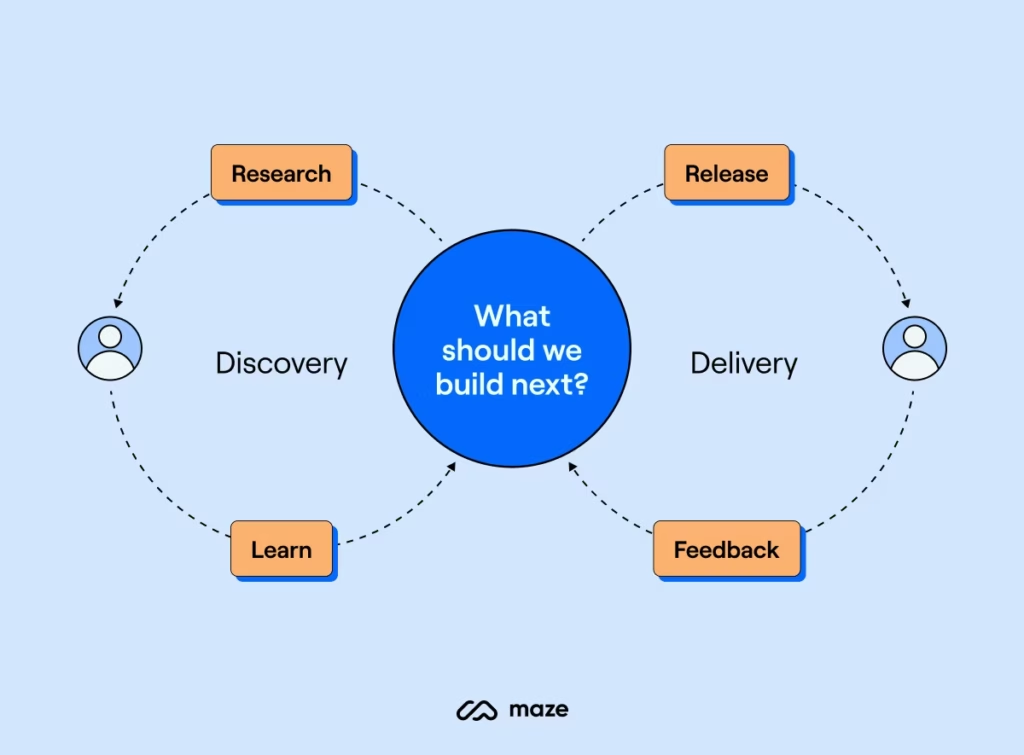
In 2026, content that exists in only one format limits its own reach. Users consume information differently depending on context, platform, and urgency. Some prefer long-form explanations, while others want short summaries, visuals, or conversational answers. Search Everywhere Optimization requires content that can travel across formats without losing its core value.
This starts by creating content with modular depth. Instead of producing isolated pieces, marketers should develop content ecosystems where a central idea is expressed in multiple forms. A research-driven article can become a video explanation, a carousel post, a voice-friendly response, and an AI-optimized summary. Each format reinforces the same message while meeting users where they are.
AI systems also favor content that is easy to extract and summarize. Clear structure, logical flow, and explicit explanations improve the likelihood that your content will be cited or paraphrased in AI-generated answers. This does not mean simplifying ideas excessively, but rather presenting them in a way that is accessible and well-organized.
Additionally, visual and audio search continue to grow. Platforms like video search engines and voice assistants play a significant role in discovery. Optimizing transcripts, captions, metadata, and contextual descriptions ensures that your content remains searchable regardless of format. When content is designed for multi-format discoverability, it naturally aligns with Search Everywhere Optimization principles.
Way Four: Strengthen Presence on Non-Traditional Search Platforms

One of the defining characteristics of Search Everywhere Optimization is recognizing that many of today’s most influential search platforms are not traditional search engines. Social networks, marketplaces, review platforms, and community forums now function as primary discovery channels.
For example, users search directly within social platforms for recommendations, tutorials, and product insights. They trust peer reviews, creator opinions, and community discussions more than branded ads. Therefore, maintaining an active, informative, and authentic presence on these platforms is critical for visibility.
Similarly, marketplaces and review platforms often appear before brand websites in search results. Optimizing product descriptions, responding to reviews, and maintaining accurate listings contribute directly to search performance and trust. In 2026, these platforms also feed data into AI systems that summarize brand sentiment and reliability.
Community platforms and niche forums also play a growing role. AI systems increasingly reference discussions and consensus from trusted communities when generating answers. Participating meaningfully in these spaces allows brands to demonstrate expertise while contributing to the broader knowledge ecosystem.
Search Everywhere Optimization recognizes that visibility is cumulative. Each platform reinforces the others. When your brand appears consistently across social, search, marketplaces, and communities, it becomes more recognizable and trustworthy, both to users and AI systems.
Way Five: Align Technical SEO with Omnichannel Discovery

While Search Everywhere Optimization expands beyond traditional SEO, technical foundations remain essential. However, technical SEO in 2026 must support omnichannel discovery rather than focusing solely on search engine crawlers.
Structured data plays a critical role here. Schema markup helps search engines and AI systems understand the context of your content, products, services, and expertise. This improves eligibility for rich results, AI summaries, and voice responses. When structured data is aligned with consistent messaging across platforms, it strengthens entity recognition.
Site performance and accessibility also influence discoverability beyond Google. Fast loading times, mobile optimization, and clean architecture improve user experience across devices and platforms. As content is shared, embedded, or referenced elsewhere, these technical factors ensure that users encounter a seamless experience.
Additionally, content indexing and API accessibility become more relevant as AI systems pull data from multiple sources. Ensuring that important content is crawlable, indexable, and clearly structured increases the likelihood that it will be incorporated into AI-driven discovery experiences.
By aligning technical SEO with broader discovery goals, businesses create a foundation that supports Search Everywhere Optimization at scale. This ensures that content is not only findable but also usable and interpretable across environments.
Way Six: Measure Visibility Beyond Rankings
One of the most challenging aspects of Search Everywhere Optimization is measurement. Traditional SEO metrics, such as keyword rankings and organic traffic, no longer tell the full story. In 2026, visibility must be measured across platforms, formats, and touchpoints.
This requires a shift toward holistic performance indicators. Brand mentions, AI citations, referral traffic from non-traditional platforms, engagement metrics, and assisted conversions all provide insight into how effectively your brand is being discovered. Monitoring how users encounter your brand across channels helps identify gaps and opportunities.
AI visibility tracking is also emerging as a critical area. As AI assistants generate answers, brands need to understand whether they are being referenced, summarized, or recommended. While this area is still evolving, early tools and methodologies focus on tracking brand presence in AI outputs and conversational search environments.
Equally important is qualitative feedback. Customer questions, support inquiries, and social conversations reveal where users are finding information and where confusion exists. This feedback loop allows marketers to refine content, clarify messaging, and strengthen visibility across channels.
By expanding measurement beyond rankings, Search Everywhere Optimization becomes a continuous improvement process rather than a static goal. This ensures that strategies remain adaptable as platforms and user behaviors continue to evolve.
The Strategic Advantage of Search Everywhere Optimization in 2026
The brands that succeed in 2026 will be those that understand search as an ecosystem rather than a destination. Search Everywhere Optimization offers a strategic advantage by aligning marketing efforts with how discovery actually happens. It allows businesses to remain visible even as platforms change, algorithms evolve, and AI reshapes user behavior.
This strategy also fosters resilience. When visibility is distributed across multiple channels, brands are less vulnerable to sudden algorithm updates or platform shifts. Instead of relying on a single source of traffic, they benefit from a diversified discovery footprint that supports long-term growth.
Moreover, Search Everywhere Optimization strengthens brand authority. Consistent presence across trusted platforms reinforces expertise and reliability. Over time, this leads to higher trust, stronger engagement, and improved conversion outcomes.
Preparing for the Future of Search
Search Everywhere Optimization is not a trend but a necessary evolution. As we move into 2026, the boundaries between search, social, AI, and discovery will continue to blur. Businesses that adapt early will gain a competitive edge, while those that cling to outdated models risk fading into obscurity.
Related Articles: 9 Biggest SEO Trends of 2025 & How to Leverage Them
By focusing on intent, building AI-readable authority, designing multi-format content, strengthening presence across platforms, aligning technical foundations, and expanding measurement frameworks, brands can build a Search Everywhere Optimization strategy that is both effective and future-proof.
Ultimately, the goal is not to chase every platform but to understand where your audience searches and how they decide. When your brand consistently appears with clarity, relevance, and value wherever those searches happen, visibility becomes a natural outcome rather than a constant struggle. This is the essence of Search Everywhere Optimization, and it is the path forward for sustainable digital growth in 2026 and beyond.
