
Social media is no longer just a communication channel. Instead, it has become a sophisticated growth infrastructure that directly influences brand visibility, customer acquisition, retention, and even product development. Algorithms are smarter, audiences are more selective, and content competition is fiercer than ever. As a result, businesses that post randomly often struggle with inconsistency, declining engagement, and unclear ROI. Meanwhile, brands that operate with structure and strategic intent consistently outperform the market.
At the center of that structure lies a well-designed social media calendar.
However, a social media calendar in 2026 is not simply a spreadsheet of dates and captions. Rather, it is a dynamic planning system that aligns business objectives, audience behavior, campaign cycles, analytics, and automation into one coherent strategy. Therefore, creating one properly requires both creativity and analytical rigor.
In this comprehensive guide, you will learn exactly how to create a social media calendar in 2026 that drives measurable business results. More importantly, you will understand how to use it as a performance engine rather than just an organizational tool.
Why a Social Media Calendar Matters More Than Ever in 2026
To begin with, it is important to understand the environment we are operating in. Social media platforms now use advanced AI models to determine what content users see. Engagement velocity, watch time, sentiment analysis, and behavioral signals all influence distribution. Consequently, inconsistent or reactive posting patterns often result in lower reach.
At the same time, consumer attention is fragmented. Users move fluidly between Instagram, TikTok, LinkedIn, YouTube, Threads, and emerging AI-driven discovery platforms. Because of this multi-platform behavior, brands must coordinate messaging strategically rather than improvising daily.
Furthermore, automation tools have made content creation easier. However, this ease has dramatically increased content volume. In other words, the barrier to entry has lowered, but the barrier to impact has risen. Therefore, a structured calendar is no longer optional. It is a competitive necessity.
A well-designed social media calendar ensures consistency, aligns teams, improves efficiency, reduces stress, and, most importantly, connects daily content to long-term business goals.
Step One: Define Clear Business Objectives Before Planning Content
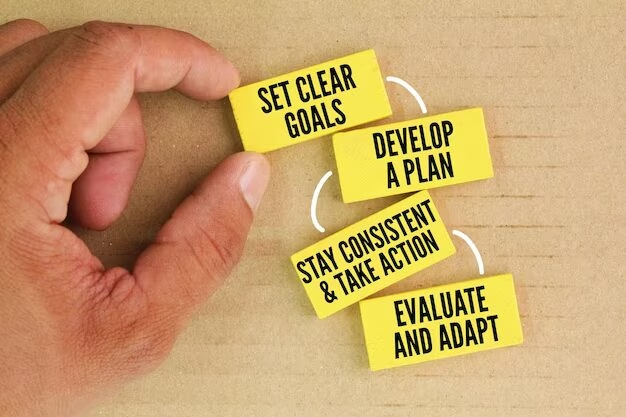
Before you start filling dates with ideas, you must first clarify what your social media presence is meant to accomplish. Without defined objectives, your calendar becomes a posting tracker instead of a growth tool.
For example, are you trying to increase brand awareness? Generate leads? Drive direct e-commerce sales? Build authority in your industry? Improve customer retention? Each objective requires a different content mix and measurement framework.
Moreover, these goals must align with broader business KPIs. If your company prioritizes revenue growth, your social media calendar should support conversion-oriented campaigns. Conversely, if your focus is brand positioning, your content may emphasize thought leadership and storytelling.
By defining measurable objectives at the outset, you create a strategic filter through which every content decision must pass. Consequently, your calendar becomes purposeful rather than reactive.
Step Two: Deeply Understand Your Audience in a Data-Driven Way

Once objectives are clear, the next logical step involves understanding your audience with precision. In 2026, surface-level demographic data is insufficient. Age and location alone do not predict behavior effectively.
Instead, focus on behavioral insights. What type of content do users save, comment on, or share? What time of day are they most active? Which topics generate longer watch times? Which formats encourage discussion rather than passive scrolling?
Additionally, AI-powered analytics platforms now provide sentiment analysis and engagement pattern forecasting. Therefore, reviewing historical performance data before building your calendar is critical.
For instance, if your short-form videos consistently outperform static posts in reach and engagement, your calendar should reflect that insight. Similarly, if educational posts drive more website clicks, you may need to allocate more space to that format.
When you base your calendar on real audience behavior rather than assumptions, you significantly increase its effectiveness.
Step Three: Establish Content Pillars That Support Business Goals
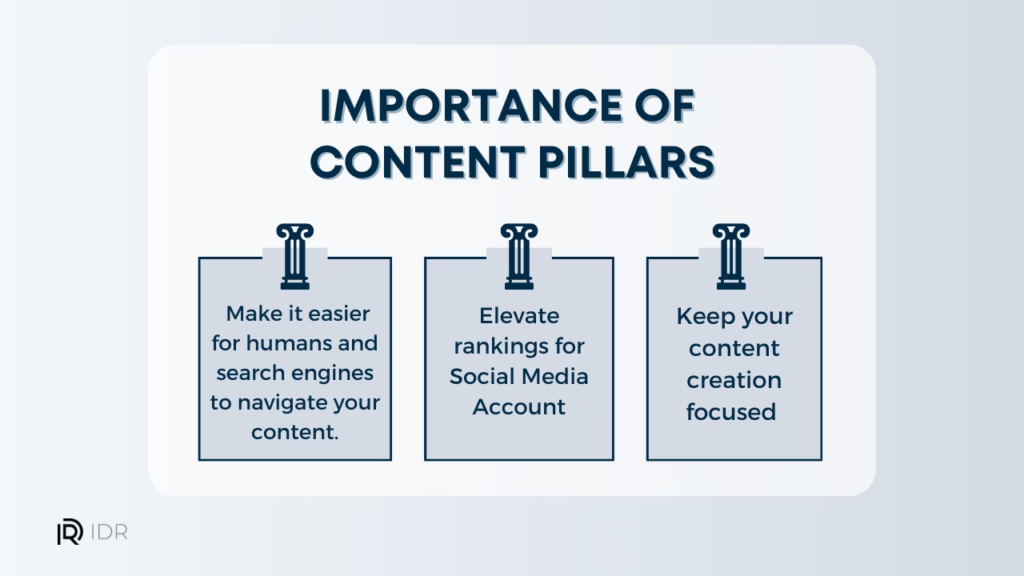
After clarifying objectives and audience insights, you should define your content pillars. Content pillars are recurring thematic categories that ensure consistency and balance.
For example, a B2B SaaS company might focus on product education, industry insights, customer case studies, and company culture. Meanwhile, an e-commerce brand might emphasize product showcases, lifestyle inspiration, user-generated content, and seasonal campaigns.
Importantly, content pillars prevent your feed from becoming repetitive or scattered. They create a predictable rhythm that audiences can recognize and trust.
However, you should not define pillars randomly. Instead, connect them to different stages of the customer journey. Awareness-stage content introduces problems and trends. Consideration-stage content offers solutions and demonstrations. Conversion-stage content reinforces trust through testimonials and offers.
By mapping content pillars to the buyer journey, your calendar becomes strategically layered rather than one-dimensional.
Step Four: Plan Campaign Arcs Instead of Isolated Posts
One of the biggest mistakes businesses make is treating each social post as an isolated event. In contrast, high-performing brands think in campaign arcs.
For example, a product launch may include teaser content, behind-the-scenes previews, educational explainers, influencer collaborations, live Q&A sessions, and post-launch testimonials. Each piece builds on the previous one.
Therefore, when building your calendar, map out entire campaign narratives over weeks or months. This sequencing builds anticipation and reinforces messaging.
Additionally, campaign arcs make performance tracking easier. Instead of evaluating single posts in isolation, you measure the cumulative impact of a coordinated effort.
Step Five: Align Publishing Frequency with Capacity and Quality
Consistency is critical. However, overcommitting can damage quality and team morale. Therefore, assess your available resources before finalizing posting frequency.
Consider your content production capacity, design bandwidth, video editing capabilities, approval processes, and community management responsibilities. A realistic schedule that maintains quality is far more effective than an aggressive one that leads to burnout.
Moreover, algorithms reward consistent engagement patterns. If you publish three high-quality posts per week consistently, you are likely to perform better than publishing daily for two weeks and then disappearing.
Sustainable consistency should guide your calendar design.
Step Six: Integrate AI Tools Without Losing Authenticity

In 2026, AI-powered tools are deeply integrated into content workflows. They assist with caption drafting, hashtag optimization, performance prediction, visual creation, and scheduling automation.
However, while AI enhances efficiency, authenticity remains essential. Audiences quickly detect generic content. Therefore, your calendar should use AI for support, not substitution.
For example, you might use AI to generate multiple headline variations, then select and refine the most compelling option manually. Similarly, predictive analytics can inform timing decisions, but human judgment should guide messaging tone.
This hybrid approach ensures scalability without sacrificing brand voice.
Step Seven: Build Flexibility into Your Calendar

Although structure is crucial, rigidity can be harmful. Social media landscapes change rapidly due to trends, cultural moments, and breaking news.
Therefore, your calendar should include flexible space for reactive content. If a trending topic aligns with your brand values, you should be able to adapt quickly.
At the same time, flexibility prevents over-planning fatigue. By allowing room for spontaneity, you keep your content fresh and culturally relevant.
A dynamic calendar balances planned campaigns with real-time engagement opportunities.
Step Eight: Embed Measurement and Optimization into the Calendar Process
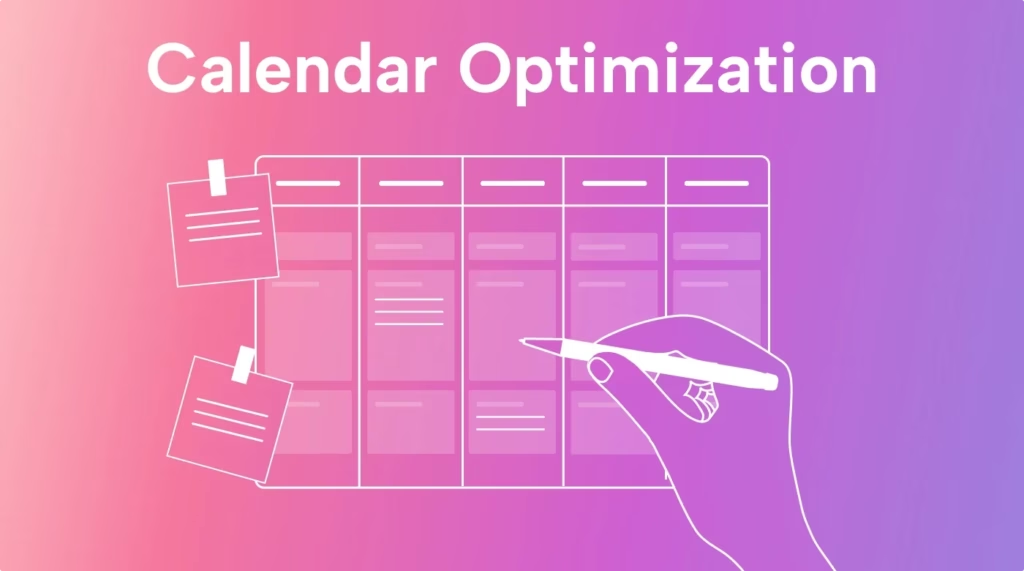
Creating a calendar is only the beginning. Continuous optimization determines long-term success.
Every piece of content should connect to specific KPIs such as engagement rate, reach, conversion rate, click-through rate, or audience growth. Over time, analyzing these metrics reveals patterns across content pillars and formats.
For instance, if video posts consistently generate higher engagement but lower conversions, you may need stronger calls to action. Conversely, if educational carousels drive more website traffic, you might increase their frequency.
Schedule regular performance reviews within your calendar cycle. Monthly or quarterly audits ensure that your strategy evolves with data.
Step Nine: Align Social Media with Broader Marketing Channels
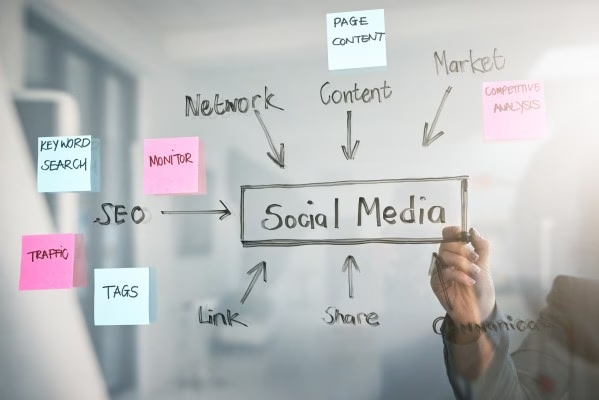
Social media should not operate in isolation. Instead, it should integrate with email campaigns, blog publishing schedules, paid advertising, product updates, and offline events.
For example, if your company publishes a major industry report, your calendar should coordinate teaser posts, highlight statistics, video summaries, and email promotions.
When messaging is synchronized across channels, brand consistency strengthens and conversion pathways become clearer.
Step Ten: Forecast and Plan for Growth
Advanced marketers now use historical data to forecast performance outcomes. By analyzing past campaigns, you can estimate expected reach, engagement, and conversions.
Although forecasts are not guarantees, they provide directional guidance for budgeting and resource allocation. Consequently, your social media calendar evolves into a predictive growth tool.
Furthermore, scenario planning allows you to test different frequency models or content mixes before fully committing.
Common Challenges and How to Overcome Them

Many businesses struggle with inconsistency, unclear ROI, or content fatigue. However, these problems often stem from poor planning rather than platform limitations.
If you feel overwhelmed, simplify your pillars and reduce frequency. If engagement declines, revisit audience data. If ROI is unclear, refine your KPIs and tracking methods.
A structured calendar provides the framework necessary to diagnose and solve these challenges systematically.
The Strategic Mindset Behind a Successful Social Media Calendar

Ultimately, a social media calendar is not about posting dates. Rather, it is about aligning creativity with analytics, storytelling with performance metrics, and daily actions with long-term strategy.
In 2026, the brands that thrive are those that treat social media as a strategic growth system. They understand that clarity reduces chaos. They recognize that consistency builds trust. And they use data not just to measure performance, but to shape future direction.
When you approach your calendar with this mindset, it becomes more than a planning document. It becomes a strategic asset.
As digital ecosystems grow more complex, structured planning becomes increasingly valuable. A thoughtfully designed social media calendar brings coherence to your messaging, discipline to your publishing, and intelligence to your optimization process.
By defining clear objectives, understanding your audience deeply, establishing strategic content pillars, planning campaign arcs, integrating AI responsibly, building flexibility, and embedding analytics into your workflow, you create a sustainable system for growth.
In 2026, success on social media will not belong to the loudest brands. Instead, it will belong to the most strategic ones. And at the heart of that strategy lies a powerful, data-driven, and intelligently managed social media calendar.
Most KPIs don’t fail because they’re wrong.
They fail because they don’t lead to action.
Too often, organizations track metrics that look impressive but aren’t tied to real decisions. Dashboards get reviewed. Numbers get discussed. Yet nothing changes.
A KPI should do more than describe performance. It should trigger ownership, clarify what can be controlled, and make the next step obvious.
If a metric doesn’t influence behavior, it isn’t a performance indicator. It’s just a statistic.
Strong analytics isn’t about measuring more. It’s about measuring what moves the business forward.
#BusinessAnalysis #DataAnalytics #KPIs #BusinessIntelligence #AnalyticsLeadership
