
Why Understanding Your Audience Is the Most Important Marketing Advantage
Marketing has changed dramatically over the past decade. Businesses now have access to more customer data, more communication channels, and more artificial intelligence tools than ever before. Companies can launch advertising campaigns across multiple platforms within minutes, personalize emails automatically, generate content with AI, and analyze customer behavior in real time. Despite these technological advances, however, one challenge continues to prevent many businesses from achieving consistent marketing success.
They do not truly understand their audience.
This may sound surprising in an age where data is abundant. After all, organizations collect information from websites, social media platforms, CRM systems, email campaigns, online stores, mobile applications, and customer support channels every single day. Yet collecting data and understanding people are two very different things.
Many marketing teams know what their customers purchased, when they visited a website, or which advertisement they clicked. However, they often struggle to explain why those customers behaved the way they did. They cannot confidently identify the motivations behind purchasing decisions, the frustrations customers experience before making a purchase, or the emotional factors that influence loyalty.
This gap explains why many marketing campaigns fail despite significant investment. Businesses frequently create products that solve the wrong problems, produce content that attracts the wrong audience, and launch campaigns that generate impressions without generating meaningful conversions. Their marketing appears active, yet the results remain disappointing.
At the center of this challenge lies one of the most valuable disciplines in modern marketing: audience research.
Audience research provides businesses with the knowledge required to understand the people they want to serve. Rather than relying on assumptions or intuition, it uncovers the needs, behaviors, expectations, motivations, and challenges that influence customer decisions. Consequently, organizations can design products more effectively, communicate more persuasively, and allocate marketing resources more efficiently.
In today’s increasingly competitive marketplace, audience research has become far more than a marketing activity. It has evolved into a strategic business capability.
Companies that understand their audiences deeply are better equipped to anticipate market changes, identify emerging opportunities, and build lasting customer relationships. Meanwhile, organizations that neglect audience research often find themselves reacting to problems rather than preventing them.
Perhaps more importantly, the rapid growth of artificial intelligence has made audience research even more valuable. AI can process enormous volumes of customer data, identify behavioral patterns that humans might overlook, and generate predictive insights at remarkable speed. Nevertheless, artificial intelligence remains dependent on one fundamental principle.
It can only generate meaningful insights when the underlying understanding of the audience is accurate.
This is why audience research continues to serve as the foundation of effective AI-powered marketing.
What Audience Research Really Means
Many people mistakenly believe that audience research simply involves identifying demographic information such as age, gender, occupation, or location. While these characteristics certainly provide useful context, they represent only a small portion of what marketers truly need to understand.
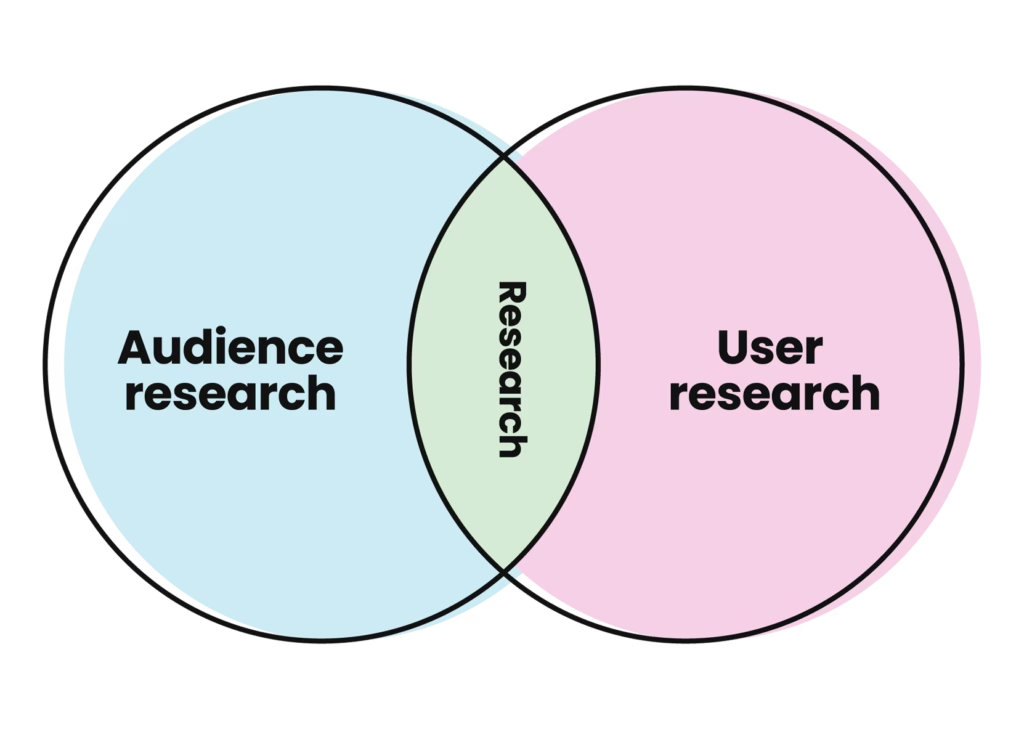
Audience research is the systematic process of discovering who customers are, what they care about, how they make decisions, what problems they are trying to solve, and why they choose one solution over another.
This distinction is important because demographics describe people, whereas audience research explains behavior.
Two customers may share the same age, income level, profession, and geographic location. Nevertheless, they may purchase entirely different products because their motivations, priorities, and expectations differ significantly.
One customer may prioritize affordability above everything else. Another may willingly pay more for convenience. A third may value sustainability, while a fourth focuses primarily on brand reputation.
Although demographic information places these individuals into similar categories, audience research reveals the deeper psychological factors that influence their decisions.
Modern marketing depends on understanding these deeper motivations.
Consumers rarely purchase products simply because they possess certain demographic characteristics. Instead, they purchase solutions to problems, ways to achieve personal goals, opportunities to reduce frustration, or experiences that align with their values.
Audience research uncovers these motivations by examining both observable behavior and underlying intent.
Consequently, organizations gain insights that extend far beyond traditional customer profiles.
Rather than asking only who the customer is, businesses begin asking what challenges customers experience, what outcomes they desire, what barriers prevent action, and what information they require before making decisions.
These questions produce significantly more valuable marketing insights.
Why Businesses Struggle Without Audience Research
Many organizations invest heavily in advertising while spending surprisingly little time understanding the people they hope to reach.
Initially, this approach may appear successful. Traffic increases. Advertisements receive clicks. Social media engagement improves.

However, over time, deeper problems begin to emerge.
Conversion rates remain disappointing.
Customer acquisition costs continue rising.
Marketing campaigns require increasingly larger budgets to achieve the same results.
Customer loyalty weakens.
Content generates attention but fails to produce meaningful business growth.
These symptoms often indicate a fundamental disconnect between the business and its audience.
Without audience research, marketing decisions become based on assumptions.
Businesses assume they understand customer priorities.
They assume they know what messaging will resonate.
They assume they recognize the factors influencing purchasing behavior.
Unfortunately, assumptions rarely survive contact with reality.
Customers continuously evolve.
Technology changes expectations.
Economic conditions influence purchasing decisions.
Cultural trends reshape consumer preferences.
Competitive offerings alter customer standards.
Organizations that fail to study these changes gradually lose relevance.
Eventually, they begin solving yesterday’s problems instead of today’s.
Audience research prevents this disconnect by replacing assumptions with evidence.
Instead of guessing what customers value, businesses observe actual behavior.
Instead of predicting customer concerns from internal discussions, they validate those concerns through direct research.
Instead of designing marketing campaigns around organizational preferences, they build campaigns around customer realities.
This shift dramatically improves marketing effectiveness.
Audience Research in the Age of Artificial Intelligence
Artificial intelligence has fundamentally changed how marketers collect, analyze, and interpret customer information.
Previously, audience research often required weeks of surveys, interviews, spreadsheet analysis, and manual reporting.

Today, AI-powered platforms can analyze millions of customer interactions within minutes.
They identify purchasing trends, behavioral segments, content preferences, sentiment changes, and emerging opportunities at a scale that was previously impossible.
However, despite these technological advances, an important misconception continues to grow.
Some marketers believe artificial intelligence has replaced audience research.
The opposite is true.
Artificial intelligence has amplified its importance.
AI excels at identifying patterns.
It recognizes correlations.
It predicts probabilities.
It processes vast quantities of information.
Nevertheless, AI cannot independently determine business context.
It cannot fully understand organizational objectives.
It cannot define strategic priorities.
Most importantly, it cannot replace genuine human curiosity about customers.
Successful organizations combine AI capabilities with thoughtful audience research.
They allow technology to accelerate discovery while relying on human expertise to interpret meaning.
This partnership creates significantly stronger marketing decisions.
For example, AI may reveal that engagement among younger audiences declined during a recent campaign.
Audience research explains why.
Perhaps messaging no longer reflects changing values.
Perhaps new competitors have shifted expectations.
Perhaps economic uncertainty has altered purchasing priorities.
Without audience research, AI provides observations.
With audience research, those observations become actionable insights.
This distinction separates data analysis from strategic marketing intelligence.
Moving Beyond Data Collection Toward Customer Understanding
Many businesses believe they understand customers because they possess extensive databases.
They know purchasing histories.
They track website visits.
They monitor email engagement.
They analyze social media interactions.

While these activities generate valuable information, they represent only one stage of audience understanding.
True audience research begins when organizations ask what the data actually means.
Why did customers abandon the purchasing process?
Why do certain audiences respond better to educational content than promotional messaging?
Why do some customers remain loyal despite higher prices?
Why do others leave after a single purchase?
These questions require interpretation rather than observation.
They require marketers to connect behavioral evidence with human motivation.
This transition transforms raw information into strategic knowledge.
Organizations that consistently practice this discipline become remarkably customer-centered.
Instead of forcing products toward audiences, they develop solutions around audience needs.
Instead of interrupting consumers with irrelevant advertising, they create valuable experiences that naturally attract attention.
Instead of competing primarily on price, they compete through relevance.
Ultimately, relevance remains one of the strongest competitive advantages any organization can develop.
It begins not with technology.
It begins with understanding people.
And that understanding begins with audience research.
