
For years, search engine optimization was largely treated as a battle for rankings. Businesses researched keywords, optimized webpages, built backlinks, improved technical performance, and created content designed to attract organic traffic. While these activities remain important, the emergence of generative artificial intelligence is changing what it means to be visible in search.
Today, consumers increasingly ask AI-powered search systems to recommend products, compare companies, explain services, identify industry leaders, and suggest the best solution to a specific problem. Instead of receiving only a list of webpages, users can receive a synthesized answer that mentions several brands and explains why particular companies may be relevant.
This transformation introduces an important new variable into search visibility: brand positioning.
In traditional SEO, a company could potentially rank for a valuable keyword even if the brand itself was not strongly differentiated. In AI-powered search, however, the system must understand what the brand represents before it can confidently mention or recommend it. Consequently, the way a company is positioned across its website, third-party publications, reviews, social platforms, industry communities, and other digital environments can influence how artificial intelligence interprets that company.
This does not mean that brand positioning has replaced traditional SEO. Instead, it means that brand positioning and SEO are becoming increasingly interconnected. A strong technical foundation may help a website become discoverable, while a strong brand identity can help AI systems understand when and why that brand should be included in an answer.
Therefore, businesses need to think beyond the question, “What keywords do we rank for?” They increasingly need to ask, “What does AI understand our brand to be known for?”
That question sits at the center of modern AI search optimization.
What Is Brand Positioning?
Brand positioning refers to the deliberate way a company establishes itself in the minds of its target audience relative to competitors.
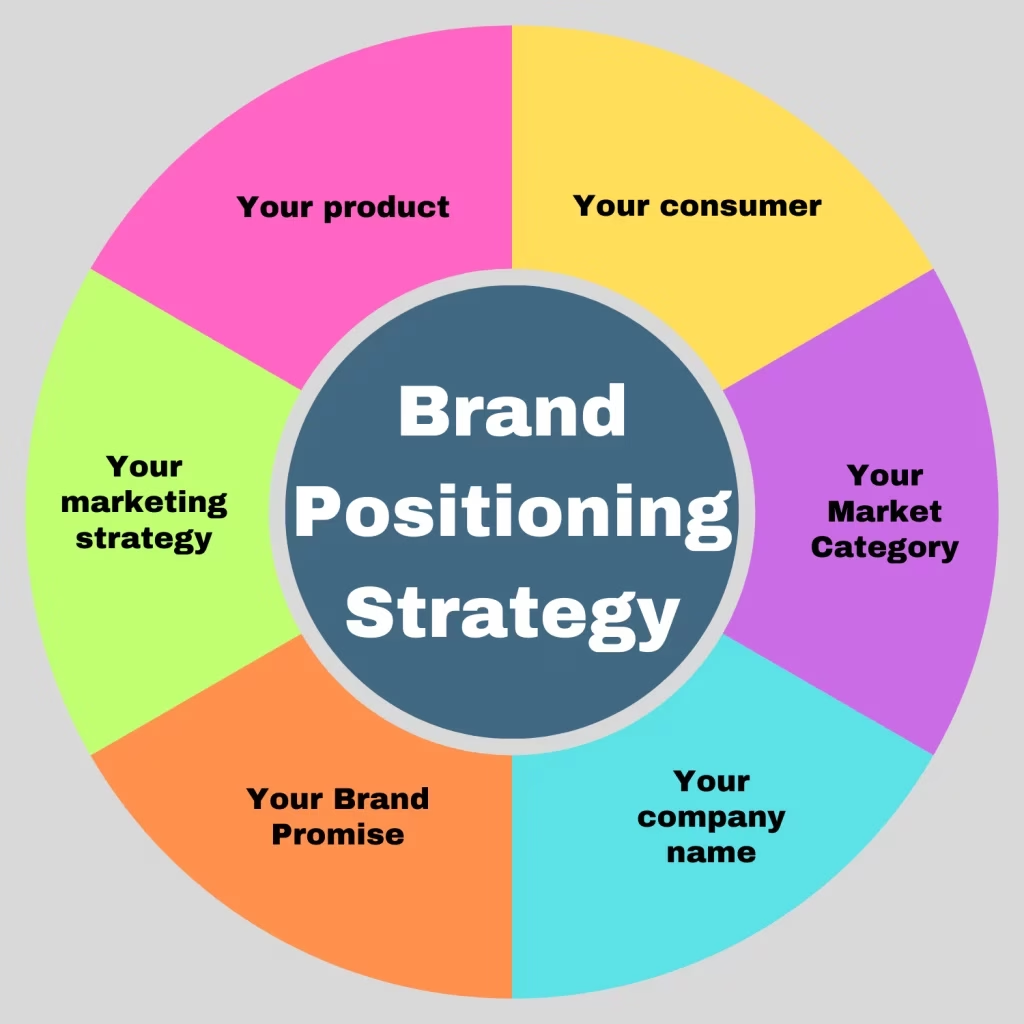
It answers a fundamental question: Why should customers associate this brand with a particular need, category, problem, or outcome?
For example, one company may position itself as an affordable solution for small businesses, while another may position itself as a premium enterprise provider. Another organization may emphasize technical innovation, while a competitor focuses on simplicity and accessibility.
These distinctions matter because brands rarely compete simply by existing within the same category. Instead, they compete for specific associations.
A customer might think of one company when considering enterprise analytics, another when searching for affordable SEO software, and another when looking for beginner-friendly design tools.
Historically, positioning primarily influenced human perception. However, the growing sophistication of AI search means positioning increasingly influences machine interpretation as well.
Large language models and AI-powered search systems need to understand the relationships between companies, products, services, industries, problems, and customer needs. Therefore, a clearly positioned brand gives these systems stronger contextual signals.
How AI Search Changes Brand Discovery
Traditional search engines generally present results based on relevance, authority, quality, and numerous other ranking signals. The user then evaluates those results independently.
Generative search changes the interaction.

A user might ask, “Which analytics platforms are best for a mid-sized e-commerce business?”
Instead of receiving ten blue links, the user may receive a synthesized response discussing several platforms and explaining their relative strengths.
That creates a different type of competition.
The question is no longer simply whether a company ranks for “analytics platform.” Instead, the company must be understood as relevant to the specific scenario described in the question.
Consequently, AI search introduces a contextual layer to visibility.
A brand may have strong organic rankings but still fail to appear in a particular AI-generated answer because the system does not associate that brand strongly enough with the user’s specific need.
This is why brand positioning is becoming an AI search variable.
Why Keywords Alone Are No Longer Enough
Keywords remain important because they reveal search demand and help search systems understand topical relevance. Nevertheless, keywords alone cannot communicate the full identity of a business.
Consider two companies targeting the same keyword.

Both may publish comprehensive articles about “business intelligence software.” Both may optimize their title tags, headings, internal links, and metadata. Both may have strong backlinks.
However, one company consistently discusses enterprise analytics, large-scale data environments, and advanced reporting, while the other focuses on affordable tools for startups and small businesses.
Although both companies target the same broad keyword, their positioning is fundamentally different.
An AI system trying to answer a question about enterprise analytics needs to understand that distinction.
Therefore, semantic context becomes increasingly important.
The system needs to connect the brand with specific entities, concepts, audiences, use cases, industries, and outcomes.
This is precisely where strong positioning provides an advantage.
AI Systems Build Context Around Brands
Large language models process relationships between concepts rather than simply matching isolated phrases.
Consequently, a brand’s digital footprint contributes to the context surrounding that entity.
If a company is repeatedly described by credible sources as a leader in a particular field, that association can become stronger.

Similarly, if customers consistently discuss the company in connection with a specific problem or use case, those associations can contribute to how the brand is interpreted.
For example, imagine a cybersecurity company that consistently publishes research about cloud security, receives industry coverage related to cloud security, and has customers discussing its cloud security solutions.
Over time, multiple independent signals reinforce the same association.
The result is a clearer digital identity.
For AI systems, that clarity can be valuable because it reduces uncertainty when determining whether the company is relevant to a particular query.
Therefore, brand positioning should not be viewed simply as a marketing slogan. It is increasingly part of the information architecture surrounding an organization.
The Connection Between Entity SEO and Brand Positioning
Entity SEO provides an important bridge between traditional search optimization and AI search.
An entity is a distinct person, organization, product, location, concept, or other identifiable object that search systems can understand as a unique thing.

Modern search engines increasingly operate around entities and relationships rather than keywords alone.
For example, an AI system may understand that a particular company provides SEO software, serves marketers, competes with other platforms, publishes research, and operates within the broader digital marketing industry.
The stronger and more consistent these relationships become, the easier it is for AI systems to understand the brand.
Therefore, businesses should ensure that their brand information is consistent across important digital properties.
The company name, description, products, services, expertise, leadership information, and areas of specialization should not contradict each other across the web.
Consistency reduces ambiguity.
Moreover, it reinforces the positioning the business wants AI systems and customers to understand.
Brand Positioning and Generative Engine Optimization
Generative Engine Optimization, commonly known as GEO, focuses on improving the likelihood that a brand or piece of content will be represented within AI-generated responses.
While GEO is still developing, one principle is increasingly apparent: visibility depends on more than individual webpages.
AI systems can synthesize information from multiple sources. Therefore, a brand’s broader digital reputation matters.
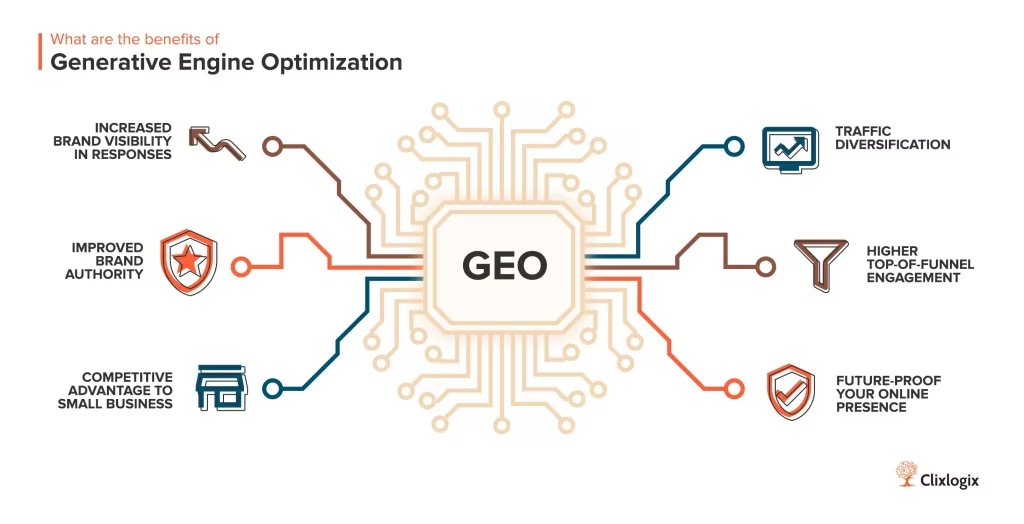
This means that optimizing a single article is not enough.
Instead, businesses need to create a consistent ecosystem of information.
Their website should communicate expertise.
Their content should reinforce their areas of specialization.
Third-party sources should provide independent validation.
Customer reviews should reflect genuine experiences.
Social profiles should maintain consistent positioning.
Industry publications should recognize the company for relevant expertise.
Consequently, GEO increasingly overlaps with digital public relations, content marketing, reputation management, and traditional SEO.
Why Third-Party Mentions Matter
One of the biggest mistakes businesses make is assuming that their own website completely defines their brand.
It does not.

AI systems can encounter information about a company across thousands of digital environments.
Industry publications, review platforms, forums, news websites, social media, business directories, podcasts, interviews, research papers, and community discussions can all contribute to the broader context surrounding a brand.
Therefore, third-party mentions can be extremely valuable.
When independent and credible sources describe a company consistently, they provide external validation.
For example, a business may describe itself as an expert in predictive analytics. However, if independent publications, customers, and industry experts also associate the company with predictive analytics, the positioning becomes more credible.
This distinction is important.
Self-description communicates intent.
Independent recognition communicates reputation.
AI search benefits from both.
Building a Distinctive Brand Position
A company cannot optimize its brand positioning effectively if it does not know what it wants to be known for.
Therefore, businesses should define a clear positioning framework before attempting to influence AI search visibility.
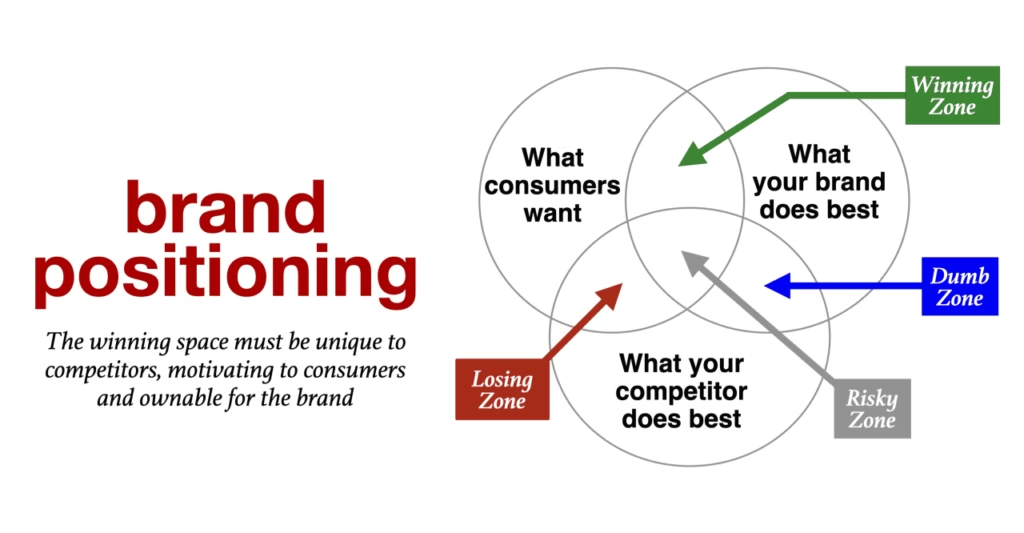
The most effective positioning is specific.
Saying that a company is “a leading digital marketing company” provides relatively little differentiation.
In contrast, positioning the company as “an AI-driven marketing analytics platform designed to help e-commerce businesses identify revenue opportunities” creates a much clearer association.
The second description identifies technology, audience, industry, and outcome.
Consequently, it gives both customers and AI systems more context.
Specificity is therefore one of the most powerful components of AI-ready brand positioning.
Connecting Positioning to Customer Problems
Strong positioning should also connect directly to customer problems.
Businesses sometimes describe themselves using internal language that customers do not use.
However, AI search increasingly reflects conversational questions and real-world problems.

Therefore, companies should understand the language customers use when describing their challenges.
For example, a business might sell “customer intelligence infrastructure,” while customers search for “how to understand why customers stop buying.”
The underlying solution may be the same, but the language differs.
Consequently, brands should connect their professional terminology with the problems customers actually experience.
This creates stronger semantic relationships between the brand and user intent.
The Role of Content in Reinforcing Positioning
Content is one of the most powerful mechanisms for reinforcing brand positioning.
Every article, guide, case study, research report, product page, and thought leadership piece contributes to the overall understanding of the brand.
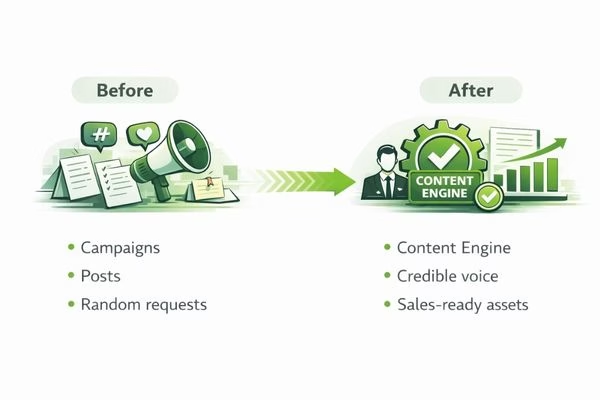
Therefore, content strategy should not be based exclusively on search volume.
Instead, it should also consider brand associations.
If a company wants to become known for AI marketing analytics, publishing hundreds of unrelated articles about general business topics may create a diluted identity.
A more focused strategy would consistently explore AI marketing, attribution, predictive analytics, customer intelligence, automation, campaign measurement, and related areas.
Over time, this creates topical depth.
Furthermore, internal linking can connect these resources into a coherent knowledge structure.
As a result, both users and search systems can more easily understand the company’s expertise.
Brand Positioning and Digital PR
Digital PR has become increasingly important in the AI search era.
When credible publications mention a company, those references create external signals that can reinforce brand associations.
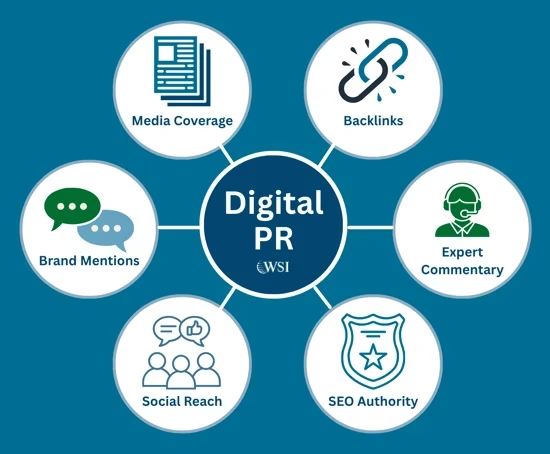
However, the goal should not simply be to generate as many mentions as possible.
Relevance matters.
A technology company seeking recognition for artificial intelligence should prioritize meaningful coverage in technology, business, analytics, and AI publications rather than unrelated websites.
Similarly, the context of the mention matters.
A brand mentioned repeatedly in connection with a specific area of expertise develops stronger associations than a brand mentioned without meaningful context.
Therefore, digital PR should be integrated with positioning strategy.
Reviews Can Strengthen or Weaken Positioning
Customer reviews represent another important component of brand identity.
Reviews reveal how real customers perceive a business.
If customers repeatedly mention that a company provides excellent customer service, that association can become part of its broader reputation.
Likewise, if customers consistently praise product reliability, ease of use, affordability, or technical expertise, these attributes contribute to brand positioning.
Consequently, review management should not focus exclusively on star ratings.
Businesses should analyze the language customers use.
This qualitative information can reveal whether the market perceives the brand in the way the company intends.
If there is a significant gap between intended positioning and customer perception, marketing strategy may need to change.
Social Media and AI Brand Signals
Social media has also become part of the broader brand information ecosystem.
Although social activity does not automatically translate into search rankings, it can contribute to visibility, reputation, and brand recognition.

When companies consistently publish expertise-driven content across social platforms, they create additional signals around their identity.
Furthermore, social discussions can generate brand mentions and reinforce associations.
Therefore, social media strategy should complement website content rather than operate independently.
The strongest approach is to communicate the same core positioning across multiple channels while adapting the format to each platform.
Measuring Brand Visibility in AI Search
One of the biggest challenges facing marketers is measurement.
Traditional SEO provides familiar metrics such as rankings, organic traffic, impressions, and clicks.
AI search introduces additional questions.
How frequently is the brand mentioned in AI-generated answers?
What topics trigger those mentions?
Which competitors are recommended instead?
How accurately does AI describe the company?
What sources appear to influence those responses?
These questions require a broader measurement framework.
Consequently, marketers should begin monitoring AI search visibility alongside traditional SEO performance.
The goal is not simply to count mentions.
Instead, businesses should evaluate whether AI systems describe the brand accurately and associate it with the strategic categories the business wants to own.
Why Brand Accuracy Matters
AI systems can sometimes misunderstand companies.
They may confuse similarly named businesses, use outdated descriptions, associate brands with incorrect categories, or provide inaccurate product information.
Therefore, brand positioning is also about information accuracy.
Businesses should monitor their digital presence regularly to identify inconsistencies.
If the website says one thing while third-party sources say something completely different, AI systems may struggle to establish a reliable understanding.
Consequently, organizations should maintain consistent corporate information across their most important digital properties.
This is particularly important for companies undergoing rebranding, mergers, acquisitions, product changes, or significant strategic shifts.
Common Brand Positioning Mistakes in AI Search
One common mistake is attempting to position a brand as everything to everyone.
Broad positioning may appear attractive because it allows businesses to target more markets. However, excessive breadth can dilute semantic clarity.
Another problem occurs when companies constantly change their messaging.
If one campaign positions a business as an affordable solution while another describes it as a premium enterprise platform, customers and AI systems may receive conflicting signals.
Similarly, publishing large volumes of unrelated content can weaken topical authority.
Finally, businesses sometimes rely too heavily on self-promotion.
AI search increasingly values independent evidence.
Therefore, companies should combine first-party content with customer experiences, expert opinions, independent coverage, research, and credible third-party references.
How AI Search Changes Competitive Positioning
AI search also changes how businesses should analyze competitors.
Traditional competitive analysis often focuses on keyword rankings, backlinks, pricing, and website features.
In the AI search era, marketers must also examine how competitors are described by AI systems.
For example, one company may consistently be characterized as the best enterprise solution, while another is described as the best option for small businesses.
These descriptions reveal positioning gaps.
If competitors own an important association, businesses need to determine whether they can credibly challenge that perception.
Alternatively, they may identify an underserved category and position themselves around it.
Consequently, AI search can become a valuable source of competitive intelligence.
Using Analytics to Refine Brand Positioning
Data should play a central role in positioning decisions.
Website analytics can reveal which topics generate engagement.
Search data can reveal which questions customers ask.
Review analysis can reveal how customers describe the brand.
Competitor analysis can reveal which associations competitors dominate.
AI search monitoring can reveal how generative systems describe the market.
When these data sources are combined, businesses gain a much clearer understanding of their position within the digital ecosystem.
Therefore, brand positioning should not be treated as a one-time branding exercise.
It should be continuously measured and refined.
The Future of Brand Positioning and Search
The relationship between branding and search will likely become even stronger as AI systems become more deeply integrated into consumer decision-making.
In the future, customers may rely increasingly on AI assistants to choose software, restaurants, financial products, healthcare providers, travel services, electronics, and countless other products.
These systems will need to understand not only what companies sell but also what those companies are best known for.
Therefore, the brands with the clearest, strongest, and most consistently validated positions will have an advantage.
Search visibility will increasingly depend on whether AI can confidently answer a fundamental question:
Why is this brand relevant to this particular user?
Businesses that can establish a strong answer to that question will be better positioned to compete.
Brand positioning is entering a new phase.
For decades, positioning primarily influenced how customers perceived companies. Today, however, it increasingly influences how AI systems interpret those companies as well.
Generative search has created an environment where visibility depends not only on whether a webpage contains the right keywords but also on whether the broader digital ecosystem communicates a clear, credible, and consistent understanding of the brand.
Consequently, businesses must begin thinking about SEO at a deeper level.
They need to build strong entities rather than isolated webpages.
They need to develop topical authority rather than publish disconnected articles.
They need to earn credible third-party recognition rather than rely entirely on self-description.
They need to understand customer language rather than simply repeat internal marketing terminology.
Most importantly, they need to create a distinctive position that both humans and machines can understand.
The future of search will not eliminate traditional SEO. Instead, it will expand the definition of what it means to optimize.
Technical SEO will still matter.
Content quality will still matter.
Links will still matter.
User experience will still matter.
However, brand meaning will matter increasingly as well.
Ultimately, the brands that succeed in AI search will be those that make themselves easy to understand, easy to trust, and highly relevant to specific customer needs. When a business consistently communicates what it does, who it serves, what problems it solves, and why it is credible, it creates a powerful digital identity that extends far beyond traditional rankings.
