
Search has changed dramatically. For years, businesses approached SEO content with a relatively straightforward objective: identify valuable keywords, create relevant pages, optimize them for search engines, and earn higher rankings. While those fundamentals still matter, the search environment of 2026 is far more sophisticated.
Today, people do not always search by typing a short keyword into a search box and browsing ten blue links. Instead, they ask detailed questions, use conversational language, compare products through AI assistants, request recommendations, and expect search engines to summarize information for them. At the same time, AI-powered search experiences are becoming increasingly capable of understanding context, intent, entities, relationships, and the credibility of information.
As a result, SEO content now has to accomplish two things at the same time. It needs to be useful and engaging for people, while also being understandable and discoverable by traditional search engines and AI-powered systems.
This is where modern SEO content strategy becomes especially important.
The goal is no longer to write content simply because a keyword has search volume. Instead, successful SEO content should answer meaningful questions, solve problems, demonstrate expertise, establish topical authority, support the customer journey, and provide information that search systems can confidently interpret.
Therefore, whether you are a business owner, marketer, SEO professional, content creator, or AI marketing specialist, understanding how to create content for both traditional search and AI is becoming essential.
This complete guide explains what SEO content means today, how search and AI systems interpret content, how to create content that satisfies user intent, how to structure pages for machine understanding, and how to build a sustainable content strategy for the evolving search landscape.
What Is SEO Content?
SEO content is content created and optimized to help a website become more visible in organic search while providing meaningful value to its intended audience.
That definition sounds simple. However, modern SEO content is much more than inserting keywords into articles.
Effective SEO content combines search intent, subject-matter expertise, content quality, technical accessibility, semantic relevance, internal linking, user experience, and business objectives.

For example, imagine a company that sells accounting software. Publishing an article titled “Accounting Software” may target a broad keyword, but it does not necessarily solve a specific problem.
A more useful article might explain how small businesses can choose accounting software, what features they actually need, how much accounting software typically costs, how implementation works, and what mistakes they should avoid.
The second approach provides significantly more context.
Consequently, it gives both users and search systems a better understanding of the subject.
This distinction is becoming even more important as AI-powered search systems increasingly generate answers from multiple sources. If your content provides clear, authoritative, and comprehensive information, it has a stronger opportunity to become part of the information ecosystem that AI uses to formulate answers.
Why SEO Content Has Changed
Traditional SEO was heavily influenced by keyword matching.
Search engines have evolved far beyond that approach.
Modern search systems can understand relationships between words, concepts, entities, topics, and user intent. They can determine that someone searching for “best laptop for video editing” may actually care about processor performance, RAM, graphics capabilities, storage, display quality, and software compatibility.

Similarly, an AI system can understand that someone asking “How do I improve my website traffic?” may need information about technical SEO, content strategy, keyword research, internal linking, backlinks, conversion optimization, and analytics.
Therefore, modern SEO content should not focus exclusively on the exact words users type.
Instead, it should address the broader information need behind the query.
This is one of the most important changes marketers need to understand.
SEO Content and the Rise of AI Search
AI has introduced a new layer to search.
Traditional search generally directs users toward webpages. Generative search can provide synthesized answers directly within the search experience.
Consequently, the competition is no longer limited to ranking webpages.
Brands increasingly need to become sources that AI systems can understand, trust, and potentially reference when generating responses.

This does not mean that traditional SEO has disappeared. On the contrary, strong technical SEO, crawlability, indexing, content relevance, authority, and user experience remain foundational.
Instead, AI search expands the requirements.
A page now needs to be useful to humans and sufficiently clear for machines to interpret its meaning.
This is why the future of SEO content is increasingly about search visibility and information visibility.
Understanding Search Intent Before Creating Content
One of the most important principles of SEO content is search intent.
Search intent refers to the underlying reason a person performs a search.
A user searching for “what is technical SEO” is probably looking for educational information. Someone searching for “best SEO audit tools” may be evaluating options. Someone searching for “Semrush pricing” is likely much closer to making a commercial decision.

Therefore, the same keyword can produce very different content requirements depending on intent.
Before creating content, marketers should ask what the user is actually trying to accomplish.
Are they learning something?
Are they comparing solutions?
Are they researching a product?
Are they trying to complete a task?
Are they looking for a specific company or website?
Understanding this distinction allows content creators to develop pages that satisfy the actual need rather than simply targeting a phrase.
Furthermore, AI-powered search makes intent analysis even more important because conversational queries frequently contain multiple requirements.
A user may ask an AI assistant to recommend affordable CRM software for a small business with a remote sales team.
That query contains several layers of intent.
The user wants software recommendations, but they also care about price, company size, remote collaboration, and sales functionality.
Therefore, content that addresses these contextual factors has a stronger chance of satisfying the query.
Creating Content for People First
The phrase “people-first content” has become increasingly important in modern SEO.
The principle is straightforward: create content because it is useful to people, not merely because you want search traffic.

This does not mean ignoring SEO.
Instead, it means SEO should support usefulness rather than replace it.
For example, an article should not repeat a keyword every few sentences simply because the phrase has high search volume. That approach often makes writing unnatural and can reduce reader trust.
Instead, use language naturally.
Explain concepts clearly.
Answer questions directly.
Provide examples.
Address common problems.
Include relevant context.
Most importantly, demonstrate that the content was created to help the reader accomplish something.
When content genuinely solves a problem, it becomes more valuable to users. At the same time, its semantic richness gives search systems more information to understand.
Therefore, people-first content is not anti-SEO.
It is one of the strongest foundations of modern SEO.
Building Topical Authority Through Content
Topical authority refers to the depth and breadth of expertise a website demonstrates around a particular subject.
Instead of publishing isolated articles about unrelated keywords, businesses can build interconnected resources around important topics.

For example, a business focused on AI marketing could create comprehensive content covering AI SEO, generative engine optimization, AI content strategy, predictive analytics, AI advertising, customer segmentation, marketing automation, AI-powered personalization, and marketing measurement.
Each article contributes to a larger knowledge ecosystem.
Furthermore, internal links can connect these resources logically.
Over time, this structure helps search engines understand the site’s areas of expertise.
It also helps users navigate from basic concepts to more advanced topics.
Consequently, topical authority benefits both traditional search visibility and AI understanding.
The Importance of Originality
AI has made content production faster than ever.
However, increased content production creates another problem: content saturation.
Thousands of websites can now publish an article about the same subject within minutes.
As a result, simply producing another generic article is becoming less valuable.
Originality therefore matters more.
Original content can include firsthand experience, original research, proprietary data, expert commentary, unique examples, case studies, experiments, interviews, and practical insights.
For instance, instead of writing another generic article about “SEO mistakes,” a marketing analytics company could analyze its own website data and identify the mistakes that produced the greatest traffic losses.
That creates information other websites cannot simply reproduce.
Consequently, original insights can strengthen differentiation, authority, and credibility.
Demonstrating Experience and Expertise
Search systems increasingly need to determine whether information deserves to be trusted.
Therefore, content should make expertise visible.
Authors should have appropriate credentials or experience where relevant.
Businesses should explain their expertise.
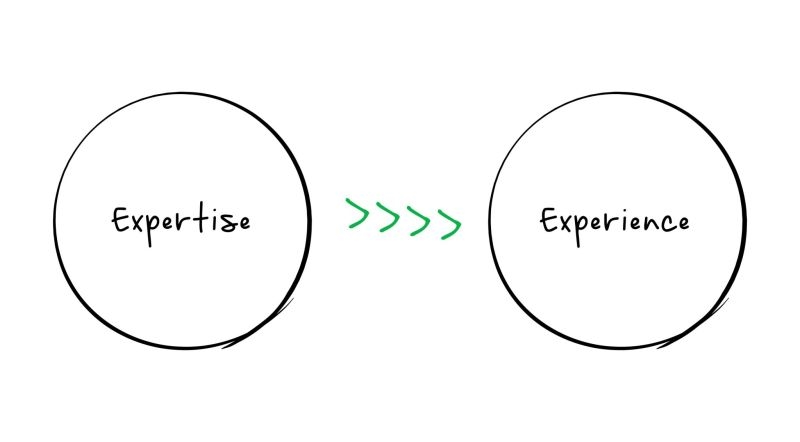
Case studies should demonstrate practical results.
Claims should be supported by reliable evidence.
Content should also be reviewed and updated when information changes.
This becomes especially important for topics involving significant financial, health, legal, or safety implications.
However, expertise is valuable across every industry.
A software developer can provide practical implementation knowledge.
A photographer can share firsthand experience with equipment.
A marketing analyst can explain how specific analytical methods work in real campaigns.
These experiences add depth that generic AI-generated content often lacks.
Structuring Content for Search and AI
Content structure is another critical part of modern SEO.
Search engines and AI systems need to interpret relationships between different pieces of information.
Clear headings help define those relationships.
A strong introduction establishes context.
Subheadings divide complex subjects into meaningful sections.
Short paragraphs improve readability.
Definitions clarify terminology.
Examples provide context.
Tables can be useful where appropriate for structured comparisons.
Internal links establish relationships between pages.
Furthermore, clear answers make individual sections easier for search systems to interpret.
For example, if an article discusses “What is domain authority?” it should provide a direct explanation before expanding into more detailed discussion.
This approach benefits both users and AI systems because the primary answer is easy to identify.
Writing Content That Answers Questions Clearly
Question-based search has become increasingly important because users frequently interact with search through conversational queries.
Consequently, content should anticipate the questions customers are likely to ask.
For example, an article about website audits should not simply explain what an audit is.

It should also address questions such as what a website audit examines, how often audits should be performed, what tools can be used, how technical problems affect SEO, and how audit findings should be prioritized.
This creates comprehensive coverage.
However, comprehensive does not mean unnecessarily repetitive.
Every section should add something meaningful.
The objective is to answer the user’s broader information need as efficiently as possible.
Using Keywords the Right Way
Keywords remain important, but their role has changed.
Instead of treating keywords as exact phrases that must be repeated throughout an article, use them as indicators of search demand and user language.
Primary keywords help define the central topic.
Related keywords reveal associated concepts.
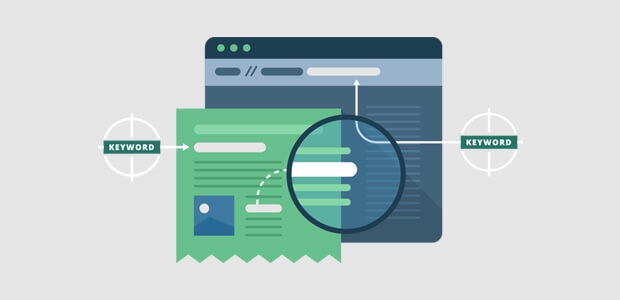
Long-tail keywords often reveal specific problems and questions.
Conversational queries reveal intent.
Together, these signals can guide content development.
For example, a website targeting “local SEO” might also need to discuss Google Business Profile optimization, local citations, reviews, map rankings, local landing pages, proximity, relevance, and prominence.
These related concepts create semantic completeness.
Therefore, the best keyword strategy is not to use more keywords.
It is to understand more deeply what those keywords represent.
Creating SEO-Friendly Titles and Headings
Titles remain important because they communicate what a page is about.
A strong SEO title should be clear, descriptive, and aligned with the user’s intent.
However, titles should also provide a reason to click.
Compare “SEO Content” with “SEO Content: A Complete Guide for Search and AI.”
The second title provides greater context.
Similarly, headings should accurately describe the sections that follow.
Avoid using headings merely to insert keywords.
Instead, use them to create a logical information hierarchy.
When titles and headings accurately describe the content, both users and search systems can understand the page more effectively.
The Role of Internal Linking
Internal linking is one of the most powerful yet frequently overlooked SEO techniques.
Internal links connect related pages within the same website.

They help users discover additional information while also helping search engines understand the relationship between topics.
For example, an article about SEO content could naturally link to related resources about keyword research, technical SEO, content optimization, search intent, AI SEO, and content analytics.
This creates a connected knowledge structure.
Furthermore, internal linking can distribute authority across important pages.
However, links should be relevant and useful.
Adding links simply to increase the number of internal links can create clutter.
Instead, each link should help the reader move naturally to the next useful piece of information.
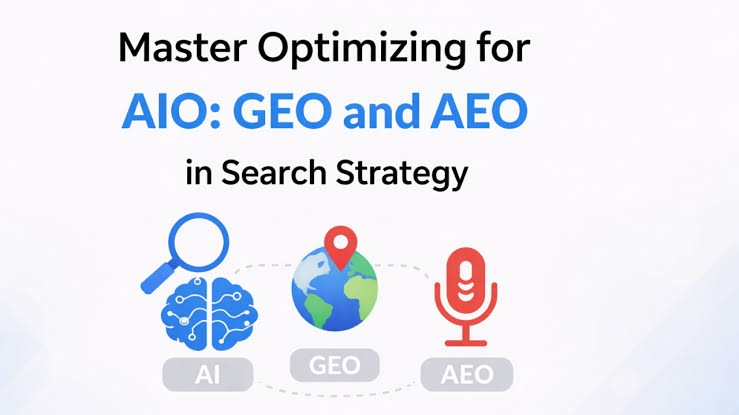
Optimizing Content for AI Overviews and Generative Search
Optimizing for AI-generated search experiences requires a slightly different mindset.
AI systems need to extract and synthesize information.
Therefore, content should make important facts easy to identify.
Definitions should be clear.
Explanations should be logically organized.

Claims should have supporting evidence where appropriate.
Entities should be clearly identified.
Relationships between concepts should be explained naturally.
For example, if discussing an SEO tool, clearly explain what the tool does, who it is designed for, what problems it solves, and how it compares with relevant alternatives.
This gives AI systems more contextual information.
At the same time, avoid trying to manipulate AI systems with artificial language patterns.
There is no reliable shortcut that guarantees inclusion in an AI-generated answer.
Instead, focus on becoming a genuinely useful source.
The Importance of Structured Data
Structured data provides additional information about webpage content in a machine-readable format.
For e-commerce websites, structured data can communicate product information, prices, availability, reviews, and other attributes.
For organizations, it can help clarify company information.
For articles, it can communicate content type and other relevant metadata.
While structured data does not guarantee AI visibility, it can improve machine understanding.
Therefore, businesses should implement relevant structured data accurately and keep it consistent with the visible content on the page.
Content Freshness and Updating
Publishing content is not the end of the SEO process.
Information changes.
Search behavior changes.
Products change.
Algorithms change.
Industries change.
Consequently, important content should be reviewed periodically.
An article published several years ago may contain outdated statistics, obsolete recommendations, broken links, or references to discontinued technologies.
Updating such content can improve usefulness and maintain credibility.
However, freshness should not become an excuse to make meaningless changes.
The objective is not to change the publication date.
The objective is to make the content more accurate, useful, and relevant.
Avoiding Thin and Repetitive Content
Thin content provides little meaningful value.
It may contain a few paragraphs that barely address the topic, provide no original insight, and exist primarily to capture search traffic.
Similarly, repetitive content can create unnecessary duplication across a website.
For example, creating dozens of pages that differ only by a few words can weaken the overall content strategy.
Instead, consolidate related information where appropriate and create genuinely distinct resources when different user intents require them.
Quality should always take priority over volume.
Using AI to Create Better SEO Content
Artificial intelligence can be extremely useful in the SEO content process.
It can help marketers analyze search intent, identify content gaps, generate topic ideas, summarize large datasets, analyze customer questions, create outlines, and accelerate research.
However, AI should support expertise rather than replace it.
Generic AI-generated content can easily become repetitive or inaccurate.
Therefore, human oversight remains essential.
An expert should verify facts, add firsthand knowledge, improve examples, refine positioning, and ensure that the final content genuinely addresses the audience’s needs.
The strongest approach is not “AI versus human.”
It is human expertise amplified by AI.
Measuring SEO Content Performance
Creating content without measuring its performance makes it difficult to determine whether the strategy is working.
Traditional metrics such as organic impressions, clicks, rankings, sessions, and conversions remain useful.
However, marketers should increasingly examine engagement and business outcomes as well.
A page receiving thousands of visitors but generating no meaningful engagement may be less valuable than a page attracting a smaller but highly relevant audience.
Therefore, content performance should be evaluated against its intended purpose.
An informational article may be designed to build awareness.
A comparison article may support evaluation.
A product page may drive conversions.
A case study may establish credibility.
Each page should have a clear strategic role.
SEO Content and Conversion Optimization
Traffic is not the ultimate goal of content marketing.
Business results are.
Consequently, SEO content should connect naturally with conversion pathways.
Educational content can introduce users to a problem.
More advanced content can explain potential solutions.
Comparison content can help users evaluate alternatives.
Product or service pages can support purchasing decisions.
This creates a logical customer journey.
However, conversion optimization should not undermine the educational value of the content.
Excessive calls to action can make an article feel promotional.
Instead, the next step should be relevant to the reader’s current needs.
When content and conversion strategy work together, organic traffic becomes significantly more valuable.
The Relationship Between SEO Content and Brand Authority
SEO content can also influence how a brand is perceived.
When a company consistently publishes accurate, useful, expert-level information, it can become associated with a particular area of expertise.
For example, a cybersecurity company that consistently produces high-quality research about cloud security can become recognized as an authority in that space.
Over time, these associations can strengthen both human trust and machine understanding.
This is particularly important for AI search because AI systems need to determine which sources are relevant and credible.
Therefore, content strategy should contribute to brand positioning rather than operate separately from it.
Preparing SEO Content for the Future of Search
The future of SEO content will likely involve an increasingly complex combination of traditional search, AI-generated answers, voice interfaces, conversational assistants, visual search, and personalized discovery.
However, the underlying principle will remain remarkably consistent.
People will continue to need useful information.
They will continue to have questions.
They will continue to compare solutions.
They will continue to look for trustworthy businesses.
Therefore, content that genuinely helps people will continue to have value.
The formats may change.
The interfaces may change.
The algorithms may change.
Nevertheless, useful information will remain fundamental.
Businesses should therefore avoid chasing every new SEO trend without understanding its underlying purpose.
Instead, build a durable content foundation based on expertise, relevance, trust, technical accessibility, and customer needs.
SEO content has entered a new era.
It is no longer enough to create an article, insert a target keyword, publish it, and wait for search traffic. Modern content strategy requires a much deeper understanding of search intent, topical authority, semantic relevance, user experience, expertise, brand positioning, and artificial intelligence.
Traditional search engines still matter. Therefore, technical SEO, keyword research, internal linking, crawlability, structured data, and high-quality backlinks remain important.
At the same time, AI-powered search is changing how information is discovered and consumed. Consequently, content must also be structured in a way that helps AI systems understand its meaning, context, credibility, and relevance.
The most effective approach is not to create separate content for search engines and another version for AI. Instead, create genuinely valuable content that works for people first and is technically and semantically clear enough for machines to interpret.
That means starting with search intent rather than keywords alone. It means creating comprehensive resources instead of shallow pages. It means demonstrating real expertise rather than publishing generic information. It means developing topical authority instead of chasing disconnected search terms. It means using internal links to build meaningful relationships between topics. It means keeping important content accurate and up to date. Most importantly, it means treating content as a strategic business asset rather than simply an SEO requirement.
As search becomes more conversational and increasingly powered by artificial intelligence, the distinction between SEO content and AI-ready content will continue to disappear.
The websites that succeed will be those that consistently provide information worth discovering, reading, trusting, sharing, and referencing.
